The 2026 Complete DIY Guide to Florida Estate Planning | Free Digital Templates
Learn how to protect your family with a Florida estate plan, Ladybird deed, Florida will, and other documents – all written in simple language and updated for the newest laws.
IMPORTANT LEGAL DISCLAIMER
Florida Probate Law Group has created these estate planning resources to empower Floridians with knowledge and tools that are useful in the estate planning process. While the forms below were created by attorneys, there is no substitute for qualified legal advice relevant to the specific facts of your individual case. Because not everyone can access an attorney, these forms are meant to expand access to estate planning to all Florida residents. The use of this free DIY estate planning resource, including downloading any forms, checklists, or utilizing interactive tools, does not create an attorney-client relationship between you and Florida Probate Law Group or any of its attorneys.
This resource is designed strictly for general educational and informational purposes. It provides a foundational framework to help individuals understand estate planning concepts under Florida law.
Estate planning is highly individual. Standardized DIY forms and templates cannot account for complex financial structures, blended family dynamics, tax minimization strategies, or specific asset preservation needs.
By using this resource, you acknowledge that you are acting as your own representative (“pro se”).
Errors in document execution (such as improper witnessing or notarization under Chapter 732, Florida Statutes) can render estate planning documents entirely void, resulting in unintended consequences during future probate or trust administration.
This resource is built exclusively around the laws of the State of Florida as of 2026. It is not intended for use by individuals residing outside of Florida, nor does it address property or assets subject to the probate, estate tax, or real estate laws of other states or countries.
By accessing, downloading, or using this free DIY estate planning resource, you acknowledge that you have read, understood, and agreed to the terms of this disclaimer.
🌴 Introduction: A New Way to Create a Florida Estate Plan
In handling thousands of probate administrations across our state, the attorneys at Florida Probate Law Group have witnessed the effects of poor planning many times over. We hope that this free resource will help families plan for the future responsibly by understanding the important choices that must be made in the present.
Estate planning in Florida has changed a lot in the last few years. Until 2020, you had to sign every paper in person, hold onto the physical documents, and hope they didn’t get lost over the decades. Now, Florida law ( Florida Electronic Wills Act (FS 732.521–732.529) allows for fully digital estate planning. This means you can make your Florida will, Florida trust, Ladybird Deed, and other documents completely electronic and complete your whole Florida estate plan online, using safe video calls and secure digital signing tools.
Whether you are drafting your own estate plan or hiring a lawyer, it is crucial that you understand what you are signing. This guide provides annotated templates accompanied by legal explanations. You’ll learn how to avoid probate, how digital wills work, how Florida trusts can protect your family, and how to store your documents safely. In order for this guide to be useful it should be read in its entirety, because proceeding without a foundational understanding of Florida law and the legal effects of each document is how people make mistakes.
Free Florida Pre Need Guardianship Designation 2026
Free Florida Living Will 2026
Free Florida Digital Assets Memorandum 2026
Inheriting vehicles in Florida
1. Why do we give this away for free?
Our firm has handled thousands of probate cases (after people die) and we have witnessed first hand how a failure to plan can become a catastrophe for a family. Due to the continued growth of our probate practice we have the privilege of providing these estate planning resources for free as a service to the community. This allows us to help people who cannot afford an attorney, and to empower those who do hire attorneys to better understand the documents they are paying for.
2. What Is a Florida Estate Plan?
A Florida estate plan is a set of legal papers that explain what should happen to your money, home, personal items, and financial accounts when you pass away or cannot make decisions. Everyone has an estate, even kids. Your estate is simply everything you own at the time of your death.
In addition to providing for who should get what, a common goal of an estate plan is to avoid the probate process. Probate is the legal process of transferring assets in court after someone dies. This is an expensive, stressful, and time consuming ordeal. There are several tools to avoid probate, including beneficiary designations, trusts, and Ladybird deeds. To learn more about the probate process in Florida, you can view our Complete Guide to Florida Probate.
Your Florida estate plan can include:
Beneficiary Designations – Paperwork done at your bank or financial institution that allows for the automatic transfer of your account upon your death.
A Florida Last Will and Testament – explains who receives your things and names someone to handle your estate. it does not avoid probate.
A Ladybird deed – provides for automatic transfer of real estate upon the death of the owner.
A Florida trust – helps your family avoid probate court and makes it easier to manage your property and digital items.
A durable power of attorney – lets someone you trust take care of bills, accounts, and property if you cannot.
A Living Will/Advance directives/Health Care Surrogate – explain your medical wishes and name a health-care helper.
An assets and digital account list – keeps track of your online accounts, passwords, and other digital items.
A combination of these documents can ensure your family knows exactly what to do and how to follow your wishes.
Each document must be properly executed in order to be legally effective (instructions on templates).
3. Estate Planning in the Digital Age
Digital estate planning means that your important legal papers can be:
Created online
Signed on a video call with witnesses
Stored in a safe digital vault
Protected from being lost, damaged, or changed
This is different from the old way, where everything was done with pen and paper. Digital estate planning is arguably safer because your documents can be stored in special databases that cannot be broken into, physically tampered with, or deleted.
The Florida Electronic Wills Act makes it possible to sign and store your will electronically. You can do everything from home, and a trusted company called a qualified custodian keeps your documents safe so they can never be changed, lost, or damaged. There are several potential advantages for fully electronic estate planning in terms of practicality and security. This guide will highlight those and cover the entire digital estate planning process in depth.
A digital Last Will and Testament requires specific language about who will be the qualified custodian securing the will for your lifetime. Other documents can generally be executed online without this specific language.
In addition to new ways to create estate planning documents, technology has also provided new types of assets to plan for, including things like your online bank accounts, photos, email, and even cryptocurrency.
📲 What Are Digital Assets?
Both the way that people create estate plans and they types of assets that need to be planned for are changing as technology reshapes our lives. Most people understand that they need to plan for financial assets, real estate, and personal property. In the modern landscape of 2026 that is not enough, and you must also make a plan for your digital assets. Digital assets are things you own online. Many people don’t realize they have dozens or even hundreds of digital items. These can be very important to your family.
Digital assets include:
Online only bank accounts
Payment apps like PayPal or Venmo
Photos and videos in the cloud
Social media accounts
Email accounts
Cryptocurrency and NFTs
Online businesses or websites
If you do not include these items in your Florida estate plan, your family might not be able to legally access them after your death. Creating a clear plan helps avoid stress and confusion later.
Florida Laws That Protect Digital Estate Plans (Explained Simply)
Florida has two important laws about digital estate planning. Here’s what they mean in simple terms:
This law says your helpers – like the person named in your Florida will or your Florida trust – can access your online accounts after you die, but only if you give them permission in writing.
This law says you can sign your Florida will online using a video meeting, and it can be stored electronically in a safe digital vault by a qualified custodian. This keeps your will protected and ready for the court when needed.
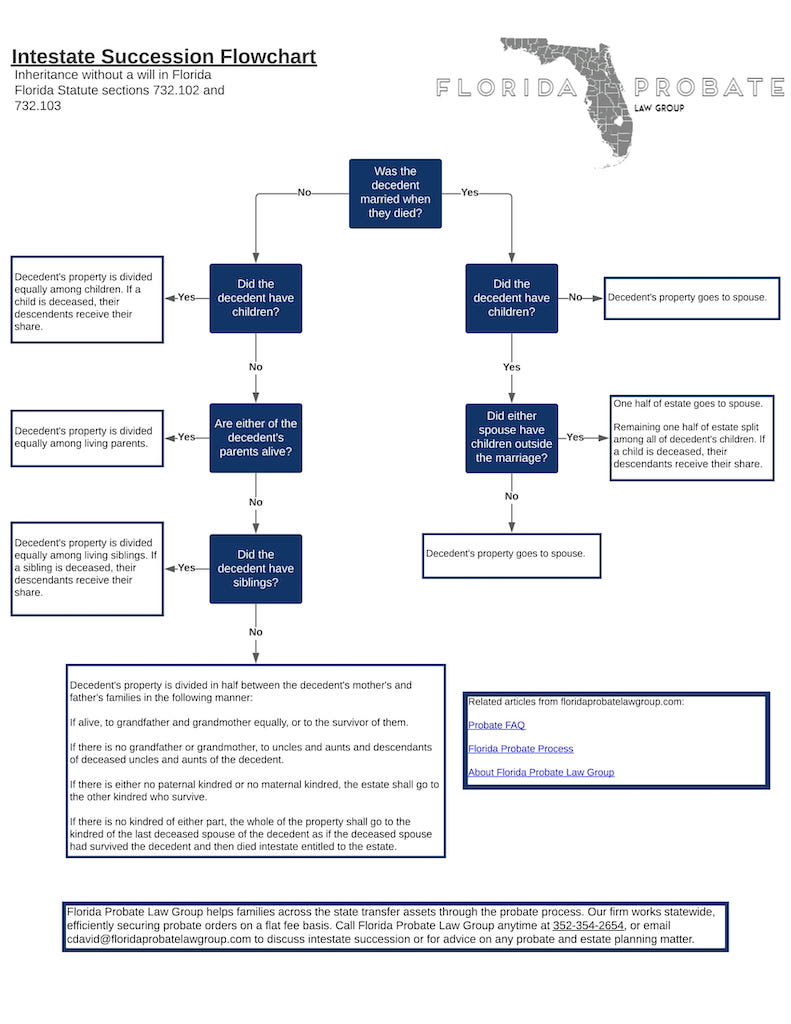
This means that your assets will go to your spouse and/or next of kin when going through the probate process. This only applies to assets held solely in your name with no joint ownership or rights of survivorship. Florida’s intestate succession laws are broken down in the flowchart below:
Through estate planning you can avoid intestate succession and in most cases avoid the probate process entirely. A Last Will and Testament does not avoid probate, but avoids intestate succession because it directs the probate court regarding who should receive your assets. Other estate planning tools, like Ladybird deeds, pay on death designations, and trust based estate plans, can avoid probate entirely. Avoiding probate is ideal because it is an expensive and time consuming process.
5. Questions to Answer before you start estate planning
Sometimes the hardest part of estate planning is the multitude of decisions involved in the process. These are some basic questions you want to know the answer to before you begin
Who should receive your assets when you die?
Who should be in charge of yourestate or trust administration in the event of your death?
If you have minor children, who should raise them if they are orphaned?
How are your current assets titled (do they have co-owners or beneficiaries)?
Who should have the right to make healthcare and financial decisions if you are incapacitated?
6. How to sign Estate Planning documents in Florida .
Documents that are not properly executed have no legal power. To legally execute estate planning documents in Florida, you must follow statutory rules for either Traditional (In-Person) or Electronic (Remote) signing. Both require a 4-person setup consisting of You, 2 Witnesses, and 1 Notary.
Traditional vs. Electronic Comparison
Requirement
Traditional (In-Person)
Electronic (RON Video Session)
Presence
All 4 people physically in the same room
All 4 people live on a recorded video session
Identity Check
Physical government photo ID
Digital ID scan + security questions (KBA)
Format
Signed in blue ink on paper
Executed via certified Remote Online Notary platform
Witness Rules
Adults; no relatives or beneficiaries
Same rules (must be physically in-person if Signer is a vulnerable adult)
Storage
Original paper stored in home fireproof safe
Digital file stored with a Florida Qualified Custodian
Witness/Notary Rules
Last Will, Trust & Power of Attorney: Require 2 Witnesses + 1 Notary.
Healthcare Documents: Require 2 Witnesses (at least 1 non-relative/non-spouse); Notary optional but recommended.
All of the templates included in this guide have signing instructions.
7. Free Simple Will Template – Florida 2026
What It Is & How It Operates
A Last Will and Testament is the traditional cornerstone of estate planning. It serves three indispensable legal functions:
It directs the distribution of your probate estate to named beneficiaries according to your exact wishes.
It nominates the Personal Representative (Florida’s statutory term for an “executor”) responsible for gathering assets, resolving legitimate debts, and distributing property.
It formally revokes all prior wills, codicils, and contradictory testamentary instruments.
A Will does not bypass probate court. Rather, it serves as the official legal roadmap that guides the probate judge and the Personal Representative through the court-supervised administration process.
F.S. § 732.503: Statutory language and requirements for Self-Proving Affidavits.
F.S. § 733.302 & § 733.304: Statutory qualification requirements and restrictions for Personal Representatives.
F.S. § 732.901: The mandatory 10-day original Will deposit rule following death.
Key Clauses & Structural Requirements
Testator Identification & Mental Capacity: Confirms the full legal name of the person creating the Will, establishes legal domicile in Florida, and affirms sound mind and voluntary intent.
Express Revocation Clause: Explicitly revokes all prior wills, codicils, and testamentary writings. Without an express revocation, ambiguous provisions across multiple old wills can trigger contentious litigation.
Personal Representative & Alternate Nomination: Naming an alternate is critical. Under F.S. § 733.302 and § 733.304, Florida enforces strict eligibility rules:
A Personal Representative must be at least 18 years old, have never been convicted of a felony, and be mentally and physically competent.
Out-of-State Non-Residents CANNOT serve as a Florida Personal Representative unless they are related to the decedent by blood, marriage, or adoption (e.g., a spouse, child, grandchild, parent, sibling, aunt, uncle, niece, nephew, or lineal relative). Appointing an out-of-state friend or distant relation will result in the court disqualifying them.
Specific Bequests vs. The Residuary Estate:
Specific Gifts: Directs distinct items of tangible property or specific monetary sums (e.g., “$5,000 to John Doe” or “my vintage watch to Jane Doe”).
Residuary Clause:The single most vital clause in the entire document. The “residue” catches everything left behind that was not specifically gifted—including unknown assets, bank accounts, refund checks, and investment portfolios. Percentages or fractional shares in the residuary clause must total exactly 100%. If an estate lacks a complete residuary clause, leftover property passes under Florida’s rigid intestate succession laws (F.S. § 732.101).
Burial & Memorial Wishes: Informs loved ones of funeral, cremation, or burial preferences, though loved ones should also be informed directly since wills are frequently read after arrangements are completed.
Strict Execution & Self-Proving Affidavits
Florida enforces strict compliance with execution formalities under F.S. § 732.502:
Signing at the End: The Testator must sign their name at the very physical end of the document. Under Florida law, any writing appearing after the Testator’s signature is completely void.
Two Subscribing Witnesses: The Testator must sign (or acknowledge a prior signature) in the presence of two witnesses, and the witnesses must sign in the presence of the Testator and each other. Witnesses must be disinterested (not beneficiaries under the Will).
The Self-Proving Affidavit (F.S. § 732.503): While a Will without an affidavit can be legally valid, it is practically defective. When a testator dies, the probate court will require an original subscribing witness to appear or execute a sworn oath testifying to the signing. A Self-Proving Affidavit is a combined oath signed by the Testator and witnesses before a Notary Public at the time of execution. It allows the Florida probate court to admit the Will immediately without tracking down old witnesses.
Electronic Wills Need a Florida Qualified Custodian
Our will template page contains free versions of both an electronic will and a traditional will. The primary difference between these two is that an electronic will must nominate someone to be responsible for the electronic file. After your electronic Florida will or Florida trust is signed, the documents are stored by a qualified custodian. This is a special company approved by Florida to keep electronic wills safe.
Your documents are stored in a secure, tamper-proof digital vault that:
Cannot lose your documents
Cannot delete them
Cannot change them
Keeps a perfect record of every action taken
This is much safer than keeping a paper will in a drawer at home, where it could be lost, damaged, or thrown away by accident.
If you create other documents at the same time – like a power of attorney, advance directives, or a Florida trust – they can be stored the same way, even though Florida law does not require it. This means everything stays organized in one secure place. The primary qualified custodian in Florida is Florida Document Services.
8. Florida Lady Bird Deed Template 2026 (Enhanced Life Estate Deed)
What It Is & How It Operates
A Florida Lady Bird Deed – formally known as an Enhanced Life Estate Deed – is one of the most effective tools available under Florida law for transferring real property automatically upon death without the delay, expense, or public exposure of probate court. Lady Bird Deeds function much like beneficiary designations for probate assets, transferring property automatically upon death while maintaining control of the property before death.
In a traditional life estate deed, the property owner (the “life tenant”) transfers the future remainder interest to a beneficiary (the “remainderman”) but loses the unilateral right to sell, mortgage, gift, or revoke the property without the remainderman’s joinder and consent. By contrast, a Lady Bird Deed reserves full lifetime control and an unrestricted power to convey. The owner retains the unfettered legal authority to live in the home, sell it, mortgage it, lease it, or even revoke the deed entirely during life – keeping 100% of the proceeds – without asking permission from the remainderman.
If the owner still holds title at the time of their death, ownership automatically passes to the designated beneficiary immediately by operation of law, completely bypassing the probate administration process.
Governing Florida Statutory Authority
Florida Statute § 689.01: Governs conveyances of real estate and statutory execution requirements.
Florida Statute § 695.26: Sets forth county recording requirements, including preparer identification and legibility standards.
The “Prepared By / Return To” Block: Under F.S. § 695.26, every deed recorded in Florida public records must explicitly state the full name, address, and firm/entity of the person who drafted the document, along with instructions on where the original recorded instrument should be mailed.
Exact Metes-and-Bounds Legal Description: A 911 street address is an informal postal designation and is legally insufficient to convey real property. The deed must recite the complete legal description (often set forth in an attached “Exhibit A”) copied verbatim from the prior recorded warranty deed. Any discrepancy in parcel boundaries, township, range, or section numbers can cloud title and necessitate an expensive corrective deed or quiet title action.
Assessor’s Parcel Identification Number (PIN / APN): The unique tax identifier issued by the County Property Appraiser must be listed to ensure proper indexing in county records.
The Enhanced Life Estate Reservation Clause: The document must contain explicit reservation language stating that the Grantor retains an unrestricted life estate with full power to convey, sell, gift, lease, mortgage, or otherwise dispose of the property and retain all proceeds. This specific language prevents the transfer from being deemed a completed gift, protecting the property from the beneficiary’s creditors during the owner’s lifetime and avoiding Medicaid transfer penalties.
Florida Homestead & Spousal Joinder: Under Article X, Section 4 of the Florida Constitution, if the property is the Grantor’s primary residence (homestead) and the Grantor is married, the non-owner spouse must join in the deed, even if the property is titled solely in one spouse’s name. A deed conveying homestead property without spousal joinder is voidable under Florida law.
Execution & Recording Formalities
To be legally valid and recordable in Florida:
Grantor Signature: Signed in the physical presence (or approved Remote Online Notarization session) of two disinterested witnesses and a licensed notary public.
Two Subscribing Witnesses: Required by F.S. § 689.01. Witnesses must sign and legibly print their full names and mailing addresses.
Notary Acknowledgment: The notary must identify the Grantor via personal knowledge or valid state-issued photo ID (Driver’s License or Passport) and affix their official notary stamp and commission expiration date.
Recording: The original signed and notarized deed must be recorded in the Official Records of the Clerk of Court in the Florida county where the real estate is physically located. Recording fees and nominal documentary stamps must be satisfied.
9. Free Florida Power of Attorney (DPOA) Template 2026
What It Is & How It Operates
A Florida Durable Power of Attorney is a comprehensive legal document that allows an individual (the “Principal”) to designate a trusted person or institution (the “Agent” or “Attorney-in-Fact”) to handle their financial, business, tax, and property affairs.
The word “Durable” has a specific legal meaning under Florida law: the Agent’s authority continues uninterrupted even if the Principal becomes mentally or physically incapacitated. Without a valid, properly drafted DPOA in place, if you suffer a severe stroke, traumatic brain injury, or cognitive decline, your family members cannot automatically manage your bank accounts or sell property on your behalf. Instead, they would be forced to petition the probate court for a burdensome, emotionally draining, and expensive legal guardianship.
Florida’s Immediate Authority Rule
Under prior Florida law, people often executed “springing” powers of attorney, which only became active upon a doctor certifying incapacity. Florida abolished springing powers of attorney on October 1, 2011. Under Chapter 709 of the Florida Statutes, all powers granted in a Florida DPOA take effect immediately upon signing. For this reason, you must select an Agent who possesses the highest degree of trustworthiness, financial acumen, and integrity.
Governing Florida Statutory Authority
Chapter 709, Florida Statutes (Florida Power of Attorney Act): Governs execution, scope of authority, fiduciary obligations, and third-party acceptance.
F.S. § 709.2201: Delineates general financial, administrative, and property powers.
F.S. § 709.2119: Mandates third-party reliance and provides statutory fee remedies against institutions that unlawfully refuse a valid POA.
The Florida Statutory “Superpowers” (F.S. § 709.2202)
Because certain financial acts carry extraordinary risks of abuse or self-dealing, Florida law strictly prohibits an Agent from performing them unless the Principal expressly grants each authority by placing their individual initials next to that specific power. Broad blanket clauses granting “all powers to do anything” are legally ineffective for these acts.
The statutory superpowers requiring separate initialing include:
Creating, amending, modifying, revoking, or terminating an inter vivos trust.
Making financial gifts to family members or charities (often critical for long-term care and Medicaid planning).
Creating or altering rights of survivorship on bank accounts or assets.
Creating or changing beneficiary designations on life insurance, annuities, and retirement plans.
Waiving the Principal’s rights to joint and survivor annuities or pension survivor benefits.
Disclaiming or renouncing property interests or powers of appointment.
Exercising fiduciary authority over electronic communications and digital assets.
Third-Party Reliance & Banking Protections
Banks, brokerage houses, and title companies frequently hesitate to accept Powers of Attorney. However, F.S. § 709.2119 protects third parties who rely on a properly executed POA in good faith. If an institution unreasonably refuses to honor an Agent’s authority within the statutory response period, Florida law allows the Agent to bring a court action where the prevailing party may recover mandatory court costs and attorney’s fees.
Execution Formalities
Signature: Must be signed by the Principal in the physical presence (or statutory RON video session) of two subscribing witnesses and acknowledged before a Notary Public.
Witness Restrictions: Witnesses must be adults. While not strictly required to be non-family members by statute, using disinterested witnesses is strongly advised to prevent undue influence challenges.
Agent Qualifications: Must be a natural person aged 18 or older, or a financial institution authorized to conduct trust business in Florida.
10. Free Florida Pre Need Guardianship Designation 2026
Florida Declaration Naming Pre-Need Guardian for Minor Children
What It Is & How It Operates
For parents of minor children, designating who will step in as legal guardian if tragedy strikes is the single most important estate planning decision. Under Florida law, a Declaration Naming Pre-Need Guardian for Minor Children allows natural parents to legally nominate a primary and alternate guardian before an unforeseen accident, illness, or death occurs.
This document remains entirely dormant during normal life. It does not forfeit, waive, or diminish any parental rights today. It is strictly “pre-need”—activating only upon a parent’s judicial incapacity or death.
Florida Statute § 744.3046: Specifically governs the creation, filing, and legal presumptions of pre-need guardianship declarations for minor children.
Florida Statute § 744.309 & § 744.312: Establishes guardian eligibility, disqualification standards, and consideration factors for judges.
The Power of the Rebuttable Legal Presumption
In Florida, a parent cannot simply “will away” custody of a child through an informal private agreement, because the state holds parens patriae authority to protect minor welfare. However, executing and filing a Pre-Need Declaration under F.S. § 744.3046 creates a legal rebuttable presumption in court.
This means that upon the parent’s death or incapacity, the probate judge must appoint the individual named in the declaration, unless the court finds, after an evidentiary hearing, that appointing the nominee is contrary to the best interests of the child. Without this document, competing relatives may engage in bitter, costly custody battles in probate court.
Guardian of the Person vs. Guardian of the Property
Florida law draws a sharp legal distinction between two types of guardianship:
Guardian of the Person: Handles physical custody, residence, daily nurturing, education, medical consent, and social upbringing.
Guardian of the Property: Manages the child’s financial assets, inheritance, life insurance proceeds, or structured legal settlements until the minor turns 18. Under Florida law, any minor who receives assets exceeding $15,000 generally requires a court-supervised property guardian, with funds placed in a court-frozen Restricted Depository.
The standard Florida statutory form nominates the chosen individual to serve as guardian of both person and property, ensuring seamless unified care unless the parent specifically partitions these responsibilities.
Essential Drafting Components
Unambiguous Child Identification: Must state each minor child’s full legal name exactly as it appears on their official birth certificate, along with their date of birth and Social Security Number.
Clear Guardian & Alternate Designation: You must provide complete legal names, current residential addresses, and contact phone numbers for both the primary guardian and at least one alternate successor.
Guardian Qualifications (F.S. § 744.309): The nominated guardian must be a competent adult aged 18 or older and must not have been convicted of a felony. A person who has been convicted of a felony or certain violent/abuse misdemeanors is legally disqualified from serving in Florida under any circumstances.
Execution & Filing Rules
Execution Requirements: Under F.S. § 744.3046, the declaration must be executed with the exact same witness formalities required for a Florida Will (two attesting witnesses signing in the presence of the parent and each other).
Filing in Public Records: The parent may deposit or file the declaration with the Clerk of the Circuit Court in their county of residence for safekeeping. Alternatively, the nominated guardian can produce and file the original document with the court immediately upon the occurrence of incapacity or death to initiate appointment proceedings.
Florida Advance Healthcare Directives: Living Will & Health Care Surrogate
Understanding the Difference
Many people confuse a Living Will with a Designation of Health Care Surrogate. While both govern medical choices, they perform distinctly different functions and work together as a complementary pair:
The Living Will is an instructional directive: it records your direct, personal decisions regarding the withholding or withdrawal of life-prolonging procedures when you are near the end of life.
The Designation of Health Care Surrogate is a proxy designation: it appoints a living spokesperson (and alternates) authorized to make broad medical choices, consult physicians, and access private medical records if you are unable to speak for yourself.
Governing Florida Statutory Authority
Chapter 765, Florida Statutes (Health Care Advance Directives):
F.S. § 765.202: Requirements and authority for Designating a Health Care Surrogate.
F.S. § 765.302–304: Statutory rules, suggested forms, and procedures governing Florida Living Wills.
F.S. § 744.3045: Nominating a Pre-Need Guardian of the Person within a healthcare surrogate designation.
The Living Will: Key Statutory Triggers & End-of-Life Choices
Under Florida’s Life-Prolonging Procedure Act (F.S. § 765.304), a Living Will does not allow doctors to withdraw care during temporary, treatable illnesses. It activates only after your attending physician and a second consulting physician formally certify that you lack capacity to make decisions AND suffer from one of three specific statutory conditions:
Terminal Condition: A condition caused by injury, disease, or illness from which there is no reasonable medical probability of recovery, and which can be expected to cause death.
End-Stage Condition: An irreversible condition resulting in progressively severe and permanent deterioration, where medical treatment would be ineffective.
Persistent Vegetative State (PVS): A permanent and irreversible condition of unconsciousness with no voluntary action or cognitive interaction with the environment.
Life-Prolonging Procedures vs. Comfort Care: The form allows you to direct the withdrawal of invasive machinery (cardiopulmonary resuscitation, mechanical ventilators, dialysis). However, Florida law ensures that pain-relief medication, palliative care, and hospice support will always be provided to ensure comfort and dignity.
Artificial Nutrition and Hydration: Directing the withdrawal of tube feeding or IV hydration requires clear indication, as physicians treat hydration and nutrition with distinct statutory protocols.
The Health Care Surrogate: Immediate Powers & Responsibilities
HIPAA Release Authority: The surrogate must have explicit authority under the federal Health Insurance Portability and Accountability Act (HIPAA) to inspect medical records, confer with treating physicians, and obtain medical histories. Florida law allows this authority to apply immediately so the surrogate can participate in evaluating capacity.
Surrogate Decision-Making Standard (F.S. § 765.205): The surrogate is legally obligated to make decisions based upon substituted judgment—meaning what they know you would have wanted based on your values, religious beliefs, and explicit instructions. If your specific wishes are unknown, they must decide based on your best interests.
Pre-Need Guardian Nomination (F.S. § 744.3045): This clause nominates your healthcare surrogate to serve as legal guardian of your person if an adversary attempts to institute a court-supervised adult guardianship against you.
Execution Formalities for Healthcare Directives
Under F.S. § 765.104 and § 765.302:
Must be signed by the Principal in the presence of two subscribing witnesses.
The Family Restriction Rule: At least one of the two subscribing witnesses must NOT be a spouse or blood relative of the Principal.
While notarization is not required for a basic Florida Living Will, having both documents notarized (or executed via Florida Remote Online Notarization) enhances interstate recognition and prevents acceptance hurdles across regional healthcare systems.
A digital asset inventory is one of the most important parts of a modern Florida estate plan. It keeps track of all your important online accounts so your helper can find and manage them. Our firm has represented many families who lost access to valuable assets because they did not have access or knowledge of what digital assets existed.
Your list may include:
Online bank accounts
Investment apps
Cryptocurrency wallets
Email accounts
Social media
Cloud storage
Online businesses
Subscription services
You should keep your list in a safe place, like:
A password manager
An encrypted file
The Verified Vault
A secure custodian vault
Click below to download your digital asset inventory template:
I was very happy with her response to my questions and concerns about Florida probate. I am in Ohio and was not familiar with the process but they cleared everything up for me and made me feel comfortable going through the probate process with my loved ones will.
Roger
Honest and straight forward assessment of complex case. My case span both federal and state issues, as well as civil case of fraud which maybe criminal fraud. He told me what he could do, what his limits of scope were and what my best/safest position should be and gave me an outline of how to get...
S. Todd
The world of probate can be fairly daunting for one who has little to no experience. Between trying to figure out what to file and when to file, there is also the where. I was quite relieved to have Nadine and Cary to guide me through the court process.
Michael O.
I highly recommend using this law group for your Florida probate needs, and in particular, Charles David. He explained clearly what my 91 year old aunt would need to do in order to sell property that was in hers and her late husband's name.
Patti T.
Florida probate law group,was very helpful in answering the many questions that I had concerning my situation their input was very appreciated thank you.