Florida Probate Law Group handles formal estate administration in every Florida county on a flat fee basis. Our firm specializes in navigating probate court efficiently, ensuring that assets are protected and distributed correctly without unnecessary stress for the beneficiaries.
Technical Overview: What is Formal Administration?
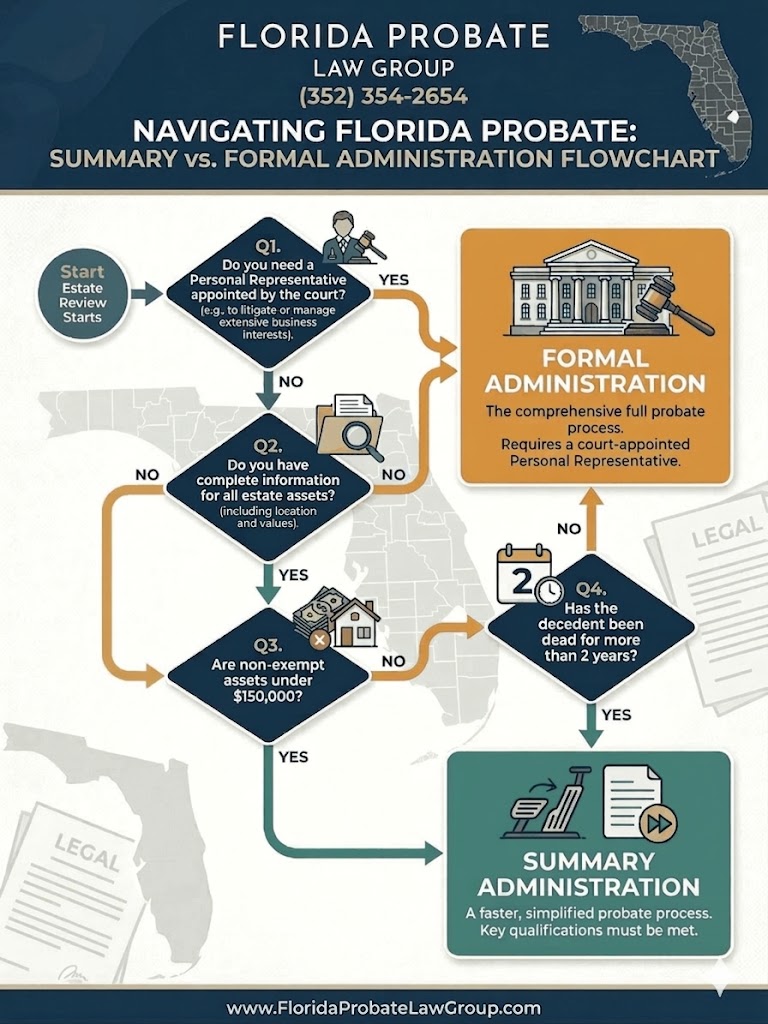
Formal administration is the traditional, court-supervised probate process used to identify a decedent’s assets, pay valid debts and taxes, and distribute the remaining property to the rightful heirs or beneficiaries. This process is required when a decedent passed away less than two years ago and owned more than $150,000 in non-exempt assets, or when someone needs to do business on behalf of an estate. The flowchart and video below break down exactly when formal administration is needed in Florida.
As of July 1, 2026 the Florida asset limit for summary probate administration will be $150,000 (If death occurred on or after July 1st 2026) OR where the decedent has been deceased for 2+ years. The asset limit threshold for summary administration is 75,000$ for anyone who died before July 1st 2026.
To understand the legal mechanics of this process, it is essential to define the core technical terms used by the court:
The Decedent: The individual who has passed away.
The Petitioner: The person (usually the surviving spouse or an heir) who initiates the probate case by filing a petition with the court.
Personal Representative (PR): In Florida, this is the officer of the court appointed to manage the estate (often called an “executor” in other states). It is their job to gather, account for, and distribute assets.
Letters of Administration: The official court document that empowers the Personal Representative to do business on behalf of the estate. No power exists to act—even if nominated in a Will—until these are issued.
Intestate: This describes an estate where the decedent passed away without a valid Will. Assets are distributed according to Florida’s intestate succession statutes (distributed to next of kin).
Testate: This describes an estate where a valid Will exists, dictating asset distribution and nominating the Personal Representative.
Notice to Creditors: A legal publication required in formal administration that gives potential creditors 90 days to file a claim against the estate.
Verified Inventory: A formal listing of all “non-exempt” assets held by the decedent at the time of death, along with their fair market value, filed within 60 days of the PR’s appointment.
Estate Bank Account: A dedicated account opened with an EIN (Employer Identification Number) and Letters of Administration where estate funds are held.
Order of Discharge: The final order signed by the judge that officially closes the probate case and releases the Personal Representative from further liability.
Why Choose Florida Probate Law Group?
Choosing the right legal partner is critical when dealing with the circuit courts. Formal administration is a technical process that demands strict adherence to the Florida Probate Code and local court rules. With hundreds of 5 star google reviews, we have built a reputation for transparency and efficiency. You can view our client testimonials and firm profile here. Our team combines decades of experience with a deep understanding of Florida’s probate courts to provide a seamless experience for families across the state. Whether you are looking for a probate lawyer to handle a straightforward estate or a probate attorney to manage complex litigation, our approach ensures your case is handled with precision.
Flat Fees: We believe in price transparency and delivering value for money. Our fee of $6,655 for a formal estate administration (as of 2026) includes all attorney time, staff time, filing fees, legal publications, and mailing withing the United States. Click here for more information about our fees and financing options.
Extensive Experience: Our firm’s founding partners bring unique qualifications to every case. We have managed thousands of estates, ranging from simple home transfers to complex multi-million dollar administrations. This deep experience allows us to anticipate issues before they cause delays.
Insider Judicial Insight: Our founding partner, Nadine David, worked in the probate court system as a staff attorney where she assisted judges with thousands of probate case. We understand what the court needs to move your case forward efficiently.
100% Remote Probate: We leverage modern technology to offer a completely remote experience. Your probate administration can be completed without ever coming to court or to the office physically. We utilize secure digital signature platforms and electronic filing systems to move your case forward regardless of where you are located.
Understanding Formal Administration in Florida
In Florida, probate is the court-supervised process of identifying and gathering a deceased person’s assets, paying taxes and debts, and distributing the balance to beneficiaries. While The Complete Guide to Florida Probate provides a full overview, it is important to distinguish between the two primary paths: Summary and Formal Administration.
Summary Administration vs. Formal Administration
Summary Administration is an expedited path. It is generally available only if the value of the “non-exempt” assets is less than $150,00 (If death occurred on or after July 1st 2026) OR where the decedent has been deceased for 2+ years. The asset limit threshold for summary administration is 75,000$ for anyone who died before July 1st 2026.
Formal Administration is the standard, full-service probate process. It is required when:
The value of non-exempt assets exceeds $150,000.
The decedent passed away within the last two years.
A Personal Representative (Executor) must be appointed to take legal action on behalf of the estate.
The estate involves complex assets or unresolved creditor issues.
The Formal Administration Process: A Step-by-Step Guide
The process is divided into several distinct phases, each requiring specific legal filings and court orders.
Phase 1: Opening the Estate and Appointing the Personal Representative
The first step is to file a Petition for Administration with the circuit court in the county where the decedent resided.
Letters of Administration: Once the court approves the petition, the judge signs “Letters of Administration.” This is the essential document that grants the Personal Representative the legal authority to act on behalf of the estate. It allows them to withdraw funds from bank accounts, sell real estate, and manage financial interests.
The 10-Day Will Rule: Florida law requires that the custodian of an original Will must deposit it with the Clerk of Court within 10 days of receiving information that the person has died. Failure to deposit the will within 10 days does not automatically invalidate the will, but can make it more vulnerable to future challenges.
Notice of Administration: We serve a formal notice to all interested parties, providing them with the opportunity to review the proceedings and raise any legal objections.
Phase 2: Inventory and Creditor Coordination
Once the estate is open, we must determine the full scope of the assets and liabilities.
Verified Inventory: The Personal Representative must file an inventory listing all “non-exempt” assets and their fair market value.
Notice to Creditors: We coordinate the publication of a legal notice in a local newspaper. This starts a 90-day statutory window for creditors to file claims. Any claims not filed within this window are typically barred forever.
Restricted Depository: In many Florida circuits, a judge may require estate funds to be placed in a “Restricted Depository.” This is a blocked bank account where no funds can be withdrawn without a specific court order, ensuring the maximum protection for beneficiaries.
Phase 3: Asset Management and Homestead Determination
One of the most critical aspects of Florida probate is the “Homestead” status of real estate.
Protected Homestead: Under the Florida Constitution, a decedent’s primary residence is often protected from the claims of most creditors. However, this protection is not automatic. We must petition the court for an “Order Determining Homestead,” which officially transfers the property to the heirs free of creditor claims.
Securing estate assets: While the inventory gives a general idea of what assets are in the estate, the personal representative may need to investigate assets with financial institutions to confirm exact balances to facilitate the estate accounting.
Phase 4: Distribution and Closing the Estate
After the creditor period has ended and all assets are accounted for, we move to the final stage.
Final Accounting: We prepare a detailed report of all financial activity within the estate. The accounting can be waived by beneficiaries but they must do so in writing.
Petition for Discharge: Once the assets are distributed to the beneficiaries, we file a petition to discharge the Personal Representative. The judge then signs an “Order of Discharge,” which officially closes the probate case and releases the Personal Representative from further liability.
Every judicial circuit in Florida has its own specific requirements. Success as a probate attorney requires more than just knowing the law; it requires knowing the local procedural landscape.
Digital Standards: We utilize 2026 digital filing standards to ensure that documents are processed by the clerk’s office without delay. This includes proper formatting for the E-Portal and the use of approved electronic signatures.
Administrative Orders: Each circuit court issues administrative orders that govern probate proceedings. We monitor these orders closely to ensure our clients are always in compliance with the latest judicial mandates.
Courthouse Locations and Clerk Information: For your convenience, you can find local judicial and clerk information and courthouse locations through the official Florida Courts website.
Frequently Asked Questions (FAQ)
What Florida assets require formal estate administration?
Non-exempt assets over 150k are required to go through formal administration in FL if the decedent passed away less that 2 years ago. Non-exempt assets are those not protected from creditors under Florida law. This typically includes bank accounts in the decedent’s name alone, investment accounts without designated beneficiaries, and real estate that does not qualify as a protected homestead.
How long does formal administration take?
While every case is unique, a standard formal administration typically takes between 6 to 12 months. The 90-day creditor period is a mandatory waiting period that accounts for a significant portion of this timeline.
What is the role of the Personal Representative in a Florida Probate case?
The Personal Representative is the person appointed by the court to manage the estate. Their duties include gathering assets, paying valid debts and taxes, and distributing the remaining property to the beneficiaries.
Can I handle probate without an attorney?
In Florida, every Personal Representative is required by law to be represented by an attorney unless they are the sole heir. However, it is extremely rare for a non-lawyer to handle their own formal estate administration. This is due to the complex and technical nature of the probate process.
Case Studies: Formal Administration in Practice
Our firm had handled hundreds of formal estate administrations across Florida. To better understand how this process works in the real world, consider these recent anonymized examples from our firm’s caseload:
High Value South FL Estate
We recently represented a client in South Florida inheriting several million dollars in assets. Other firms wanted to charge 3% of the inheritance or to charge the client by the hour. We saved this client a significant amount of money with our flat fee, and because we are not incentivized to drag cases our to bill additional hours, their inheritance was transferred efficiently with no delays.
Remote Administration for Out-of-State Heirs
In a recent estate involving a standard distribution of residential property and financial accounts, the beneficiaries lived in several different states. Using our 100% remote workflow, we facilitated the entire formal administration digitally. The Personal Representative and all heirs executed their documents via secure electronic platforms, and the entire process – from the initial petition to the final order of discharge – was completed without any of the parties ever having to travel to a Florida courthouse or office.
Strategic Asset Recovery via Formal Administration
In one case, a family needed to settle the estate of a deceased relative who was involved in a pending liability claim. Because the decedent held a significant casualty insurance policy, a formal probate was necessary to appoint a personal representative to sign a release and receive the settlement. We managed the appointment of a Personal Representative to oversee the insurance coordination, ensuring the estate was protected and the policy proceeds were properly managed. This allowed the family to resolve the liability claim and receive damages owed to their deceased relative.
Wrongful Death and Estate Appointment
We frequently handle cases where a formal administration is required specifically to pursue a wrongful death claim. In these sensitive situations, the court must appoint a Personal Representative to act as the legal voice for the deceased. We successfully navigated the probate requirements to secure Letters of Administration, enabling the family’s litigation counsel to move forward with their claim and eventually distribute the recovery to the surviving heirs.
Start Your Probate Today
If you are facing the complexities of an estate that requires formal administration, do not navigate the system alone. Our team is ready to provide the expert guidance and “Authority Engine” efficiency you deserve.
Contact Florida Probate Law Group today at (352) 354-2654 to schedule a consultation. Our 100% remote process ensures that we can help you, no matter where you are located. Let our experience be your peace of mind.
I was very happy with her response to my questions and concerns about Florida probate. I am in Ohio and was not familiar with the process but they cleared everything up for me and made me feel comfortable going through the probate process with my loved ones will.
Roger
Honest and straight forward assessment of complex case. My case span both federal and state issues, as well as civil case of fraud which maybe criminal fraud. He told me what he could do, what his limits of scope were and what my best/safest position should be and gave me an outline of how to get...
S. Todd
The world of probate can be fairly daunting for one who has little to no experience. Between trying to figure out what to file and when to file, there is also the where. I was quite relieved to have Nadine and Cary to guide me through the court process.
Michael O.
I highly recommend using this law group for your Florida probate needs, and in particular, Charles David. He explained clearly what my 91 year old aunt would need to do in order to sell property that was in hers and her late husband's name.
Patti T.
Florida probate law group,was very helpful in answering the many questions that I had concerning my situation their input was very appreciated thank you.