Statewide Probate
Attorneys in Florida
Attorneys in Florida


Summary administration in Florida is the fastest and most affordable probate option for qualifying estates. Florida summary administration allows families to settle estates worth less than $150,000 in non-exempt assets if death occurred on or after July 1st 2026 OR where the decedent has been deceased for 2+ years. The asset limit threshold for summary administration is 75,000$ for anyone who died before July 1st 2026.
or estates where the decedent passed away more than two years ago. Unlike formal administration, summary administration in Florida does not require appointing a personal representative, making it significantly faster, typically completing in 2–3 months versus 6–12 months for formal probate. At Florida Probate Law Group, we handle summary administration cases statewide for a flat $3,500 fee, including all court costs and certified mailings.
Quick Facts: Florida summary administration is governed by Chapter 735 of the Florida Statutes. Our flat fee of $3,500 covers everything attorney fees, court filing costs, and all certified mailings. The entire process is handled 100% remotely. We serve all 67 Florida counties. Free consultation: (352) 354-2654.
Not every estate can use Florida summary administration. The law sets two separate eligibility tracks. Your estate only needs to meet one of these two conditions to qualify:
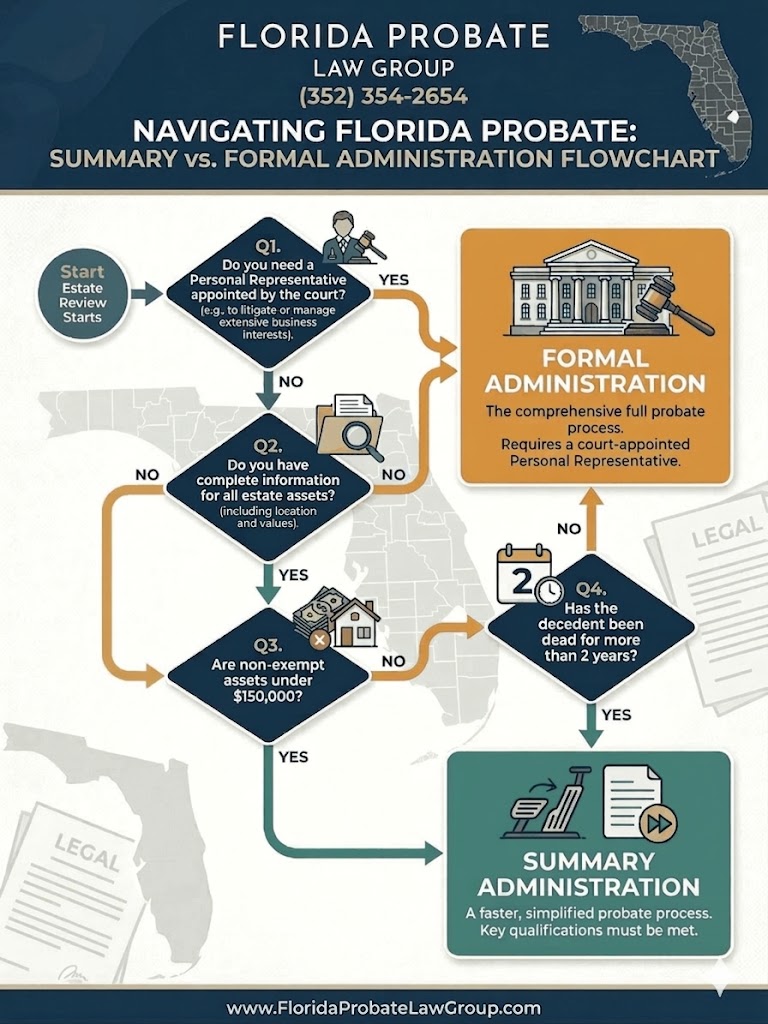
Florida summary administration vs. formal administration eligibility flowchart — Florida Probate Law Group
Track 1: Non-Exempt Assets of $150,000 or Less
If the total fair market value of the decedent’s non-exempt probate assets is $150,000 or less, the estate qualifies for Florida summary administration regardless of when the person died. The key here is the word “non-exempt.” Florida law excludes certain assets from this calculation entirely.
Exempt assets (excluded from the $150,000 calculation) include:
Non-exempt assets — the ones that do count toward $150,000 — include:
Getting this calculation right matters. Miscounting can push an estate into formal administration unnecessarily, costing your family more time and money. Our attorneys review every asset carefully before recommending a path forward.
Track 2: Decedent Has Been Deceased for More Than Two Years
If more than two years have passed since the date of death, the estate automatically qualifies for Florida summary administration, regardless of how much it’s worth. There’s no asset value limit under this track.
The reason: Florida’s two-year non-claim statute (§733.710) bars virtually all creditor claims after two years from the date of death. With creditors effectively barred, there’s no need for the extensive creditor process that formal administration requires. The only goal at that point is transferring title to the right heirs.
This track is especially useful for families who delayed starting probate, sometimes by years. The good news is that it makes the process simpler, not harder.
Most law firms charge hourly for probate work, and the bill keeps climbing as the case progresses. At Florida Probate Law Group, we don’t bill by the hour. Our Florida probate summary administration is handled on a fixed flat fee of $3,500, and that number covers everything.
Here’s exactly what’s included in your $3,500 flat fee:
There are no hidden fees. We don’t charge a percentage of the estate’s value. You’ll know the total cost upfront, before you sign anything.
Comparison: Formal administration at Florida Probate Law Group starts at $5,500+. Summary administration is not only faster, but it also saves families an average of $2,000 or more in legal costs.
Understanding what actually happens in a summary probate case in Florida takes the mystery out of the process. Here’s how it works from start to finish with our firm:

Both summary and formal administration are legitimate probate paths in Florida. The right choice depends on the estate’s specific circumstances. Here’s a direct comparison:
| Feature | Summary Administration | Formal Administration |
|---|---|---|
| Timeframe | 2–3 months | 6–12 months |
| Cost (Our Flat Fee) | $3,500 | $5,500+ |
| Personal Representative Required | No | Yes |
| Eligibility | Under $150K non-exempt assets OR 2+ years since death | Any estate |
| Creditor Process | Simplified (or eliminated if 2+ years) | Full creditor notification and claim period |
| Court Oversight | Minimal | Ongoing throughout process |
| Remote Process | Yes — 100% remote | Yes — 100% remote |
Even if an estate technically qualifies for Florida summary administration, formal administration may be the smarter option in these situations:
If you’re unsure which route applies to your situation, a free consultation with our team will give you a clear answer fast. Read our complete Florida probate guide for a broader breakdown of both processes.
Florida’s 67 circuit courts each operate with some degree of local variation. The core requirements for Florida summary administration come from state statute, but the specific forms, filing procedures, and processing timelines differ meaningfully from county to county.
For example:
Our attorneys stay current on the local rules across all Florida circuits. We’ve handled summary probate Florida cases in every part of the state — from Pensacola to Key West and everywhere in between. No matter what county your loved one lived in at the time of their passing, we can file there.
Need Tampa summary administration? Visit our Tampa probate attorney page for Hillsborough County-specific details. Handling an estate in Broward? Our Fort Lauderdale probate attorney pagecovers the 17th Circuit’s local procedures. You can also browse our full Florida Probate by County resource library for county-specific guides.
Two topics come up in almost every Florida summary administration case: homestead property and debts. Both require careful handling.
The decedent’s primary residence is usually the most valuable asset in the estate. While Florida’s constitution provides strong homestead protections under Article X, Section 4, those protections don’t transfer the title automatically. You still need a court order.
In a summary administration that involves homestead real estate, we file a separate Petition to Determine Homestead Status of Real Property alongside the main petition. The judge issues a Homestead Order that officially confirms the property’s protected status and authorizes its transfer to the correct heirs. Once that order is recorded in county public records, the property can be sold or transferred with clear title.
Our founding partner, R. Nadine David, spent time as a staff attorney for a Florida probate court before entering private practice. That experience gives our team an inside perspective on how judges evaluate homestead petitions — and how to draft them to move through the system efficiently.
If the decedent passed away less than two years ago, all known or reasonably ascertainable debts must be addressed before the court will grant the Order of Summary Administration. The petitioner must either pay the debts or demonstrate that sufficient non-exempt assets exist to cover them. If this step is skipped, heirs risk becoming personally liable for those debts — up to the value of the assets they receive.
If the decedent has been deceased more than two years, Florida’s two-year non-claim statute automatically bars most creditor claims. This significantly simplifies the process and allows asset distribution without requiring creditor payment in most cases.
A family in Ohio contacted us after their father passed away in Gainesville, Florida. He left behind a checking account ($18,500), a savings account ($22,000), and a vehicle — totaling approximately $48,500 in non-exempt assets. The family didn’t know where to start and assumed they’d need to hire a local attorney and fly to Florida multiple times.
After a free 30-minute phone consultation, we confirmed the estate qualified for summary administration Florida based on the $150,000 non-exempt asset threshold. Our flat fee was $3,500 — all-inclusive. The family signed everything electronically from Ohio. We filed the petition in Alachua County and handled all communications with the court and creditors on their behalf.
The Order of Summary Administration was issued approximately 10 weeks after our first consultation. The family accessed both bank accounts and transferred the vehicle title without ever setting foot in Florida. Total cost to the family: $3,500. Estimated cost under formal administration: $6,000 or more, with a timeline of 9–12 months.
Note: Client details have been generalized to protect privacy. Results vary based on case complexity and court processing times.
There are plenty of law firms in Florida that handle probate. Most of them also handle personal injury, family law, criminal defense, and a dozen other practice areas. We don’t. Probate is all we do, and that focus matters when you’re trying to move an estate forward quickly and affordably.

Our summary administration attorney Florida team is ready to evaluate your estate, confirm eligibility, and give you a clear timeline — at no cost to you. Call us at (352) 354-2654 or fill out the contact form on this page.
Summary administration in Florida is a streamlined probate process governed by Chapter 735 of the Florida Statutes. It’s available for estates with $150,000 or less in non-exempt assets, or when the decedent passed away more than two years ago. Unlike formal administration, it doesn’t require appointing a personal representative. Instead, the court issues an Order of Summary Administration that transfers assets directly to beneficiaries. The process typically completes in 2–3 months.
An uncontested summary administration in Florida typically takes 2–3 months from filing to the issuance of the Order of Summary Administration. The timeline depends on the county court’s current caseload, the number of creditors and beneficiaries involved, and how quickly all parties return signed documents. Complex cases with multiple creditors or disputed assets may take longer. This is still substantially faster than formal administration, which commonly runs 6–12 months or more.
At Florida Probate Law Group, the total cost for a summary administration is a flat $3,500 including all attorney fees, court filing fees, and certified mailings within the United States. We don’t charge hourly, and we don’t take a percentage of the estate. That $3,500 is the complete price you’ll pay from start to finish.
An estate qualifies for summary administration if its non-exempt assets total $150,000 or less OR if the decedent has been deceased for more than two years, regardless of asset value. Exempt assets (homestead property, up to $20,000 in household furnishings, two vehicles, and $1,000 in personal property) do not count toward the $150,000 threshold. Non-exempt assets include bank accounts without POD designations, non-homestead real estate, and business interests, among others.
Yes. Florida law requires attorney representation for all probate proceedings, including summary administration. An attorney prepares the petition, coordinates joinder from all beneficiaries, handles creditor notices, and files the correct documents with the circuit court. Attempting to handle this without an attorney almost always results in rejected filings and significant delays. At Florida Probate Law Group, we handle the entire process for a flat $3,500 fee and it’s all done remotely.
Yes. Exempt assets are protected from most creditor claims and don’t count toward the $150,000 non-exempt asset threshold but they still need to pass through the probate process in order to change legal ownership. The homestead property, for example, requires a court order confirming its status and directing its transfer to heirs before a new deed can be recorded. Exempt assets can’t simply be claimed by beneficiaries without court authorization.
No. Our 100% Remote Probate process means you can manage every step from wherever you are — Ohio, California, or overseas. We use secure electronic signature platforms, video conferencing, and digital court filing. You’ll never need to appear in a Florida courtroom or visit our office in person. For city-specific information about local court procedures, see our Florida Probate by City guides.
If the decedent passed away less than two years ago, provision must be made for all known or reasonably ascertainable debts before the court will issue the Order of Summary Administration. If that provision isn’t made, heirs can become personally liable (§735.206(4)) for debts up to the value of property they receive. If the decedent has been deceased for more than two years, Florida’s non-claim statute generally bars most creditor claims, allowing distribution to proceed without creditor payment.
Florida law requires the person in possession of an original Last Will and Testament to deposit it with the Clerk of Court in the county where the decedent lived within 10 days of learning of their passing. This is required even if you haven’t decided to start probate yet. Failing to deposit the will within 10 days doesn’t invalidate it, but it can increase its vulnerability to challenges. More information is available in our Florida Probate by County guides.
Yes. Summary administration can transfer both homestead and non-homestead real estate. For homestead, a separate Petition to Determine Homestead Status is filed concurrently. For non-homestead real estate, the Order of Summary Administration is recorded in county public records and serves as conclusive evidence of the ownership transfer. Managing multiple properties across different counties may sometimes make formal administration more practical — our attorneys can help you evaluate this based on your specific situation. See our Florida Probate by County guides for county-specific recording requirements.
Our summary administration attorneys handle cases in all 67 Florida counties for a flat $3,500 fee — all-inclusive, 100% remote. Most cases close in 2–3 months. There’s no obligation to speak with us.
Call (352) 354-2654 for a free consultation, or fill out the contact form on this page and we’ll get back to you the same business day.
For more detailed information on Florida’s probate process as a whole, read our complete Florida probate guide. You can also explore Florida Probate by City for court-specific procedures in your area.