Statewide Probate
Attorneys in Florida
Attorneys in Florida


Losing a loved one in Punta Gorda, Port Charlotte, or Englewood requires a probate firm that understands the specific technicalities of the 20th Judicial Circuit. In Charlotte County, “near enough” is not good enough for the court registry—filings must be exact to avoid immediate rejection.
At Florida Probate Law Group, we provide families with a clear, predictable path through the legal system. To understand the broader requirements of estate law, we recommend reviewing our Complete Guide to Florida Probate. Our statewide probate attorneys specialize in Charlotte County cases, offering all-inclusive flat-fee pricing for every uncontested estate.
Probate and guardianship matters are handled at the main Justice Center in downtown Punta Gorda.
[!IMPORTANT]
2026 Filing Tip: While the Clerk’s primary office is in Punta Gorda, there is a satellite office at the Murdock Administration Building in Port Charlotte. However, original Wills must be deposited at the Punta Gorda location to ensure they are properly matched with your digital case file.
Charlotte County judges (including Judge Donald H. Mason and the 20th Circuit bench) require strict adherence to local “Best Practices.”
Current court costs as of early 2026 (not including convenience fees):
| Action | Estimated Filing Fee |
| Formal Administration | $400.00 |
| Summary Administration (Estates > $1,000) | $345.00 |
| Summary Administration (Estates < $1,000) | $235.00 |
| Opening Safe Deposit Box | $42.00 |
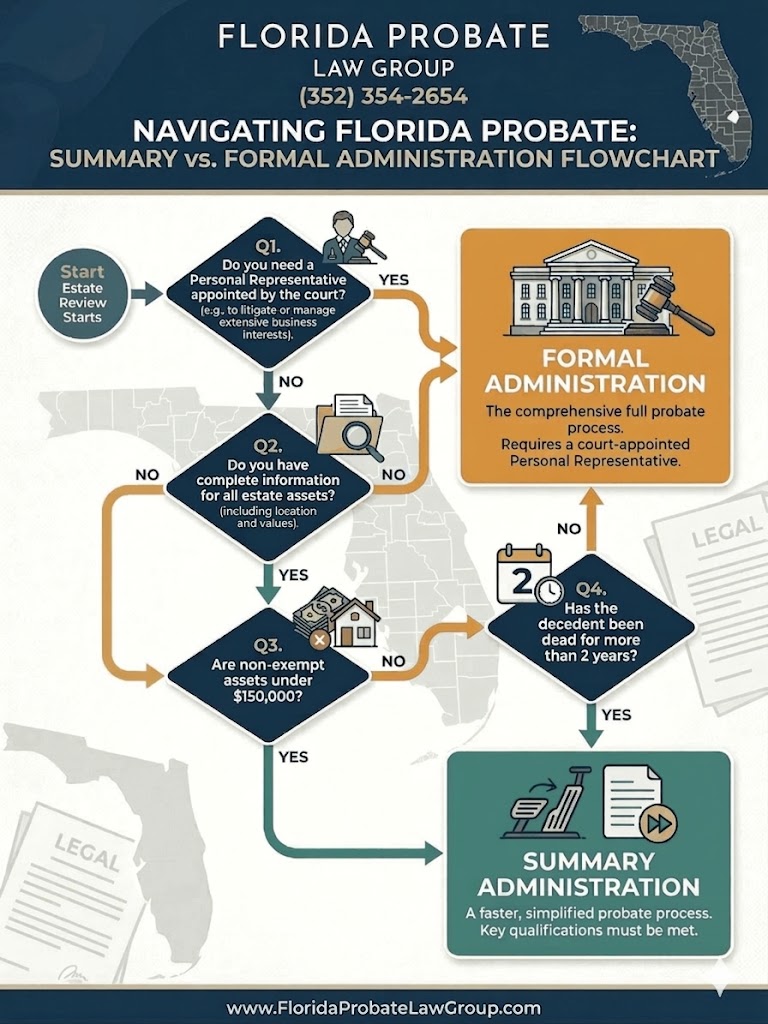
Yes. Per Florida Probate Rule 5.030, every personal representative must be represented by an attorney unless they are the sole interested party. This protects the rights of creditors and other beneficiaries. Most Summary administrations also require the help of an attorney.
For estates that qualify (non-exempt assets under $150k or decedent deceased for 2+ years), our firm can often complete the process in 2-3 months, or even fasted depending on the responsiveness of the client and court.
The original Will must be deposited with the Charlotte County Clerk of Court in Punta Gorda within 10 days of learning of the death. Our firm manages this process for our clients to ensure legal compliance.
At Florida Probate Law Group, we eliminate the uncertainty of hourly billing. We provide a single, all-inclusive flat fee for uncontested probate cases. You will know the total cost before we file a single document.
Our firm brings “insider” judicial experience to the 20th Judicial Circuit.
Florida Probate Law Group has helped thousands of families through the probate process on an affordable flat-fee basis. Backed by hundreds of 5-star Google reviews, our legal team streamlines estate administration for local and out-of-state families alike, removing the stress of navigating the Florida court system during a time of grief. In this case study, we review how our firm efficiently expedited an intestate summary administration in Charlotte County, ensuring proper distribution to a surviving spouse and multi-jurisdictional heirs while settling estate liabilities seamlessly.
| Case Element | Profile Details |
| Venue | Twentieth Judicial Circuit of Florida |
| County | Charlotte County |
| Administration Type | Summary Administration (Non-exempt estate value under $150,000) |
| Core Issues | Intestate succession, multi-jurisdictional heirs (Florida, Wisconsin, and Texas), prioritization of creditor claims (Class 1 and Class 2) |
| Service Model | 100% Remote Estate Representation |
Navigating probate in the Twentieth Judicial Circuit requires strict adherence to localized procedural mandates. The Charlotte County Clerk of the Circuit Court & Comptroller and local judges enforce unique “Best Practices”. Most notably, Charlotte County judges will not review a petition without a corresponding “Mandatory Probate Checklist”. Attorneys must complete and e-file this specific checklist as part of the document package; failure to include it results in the proposed orders being rejected or deleted unsigned.
Furthermore, unlike many Florida counties where proposed orders are routed directly through the Clerk, Charlotte County requires proposed orders to be submitted directly to the assigned judge via the Florida Courts E-Filing Portal. Original wills must be physically deposited at the main Justice Center in Punta Gorda rather than at satellite administration offices. Our technical proficiency with these localized digital submission rules ensured this case moved straight to the judge’s desk without deficiency notices or administrative delays.
The timeline of this estate administration unfolded through a highly organized sequence of legal actions:
A common misconception about Summary Administration is that it can only be used if a decedent has absolutely no outstanding debts. In reality, Florida Statute Section 735.201 allows an estate to qualify for Summary Administration as long as the value of the non-exempt probate estate does not exceed $150,000 (excluding protected property like a homestead) OR if the decedent has been dead for more than two years.
If an estate goes through Summary Administration and has known debts, the petitioner must state that provision has been made for the full payment of all distinct creditors. Florida Statute Section 733.707 dictates a strict hierarchical order for how estate liabilities must be categorized and paid:
By explicitly accounting for these claims on Schedule A of the petition, the court can legally order a financial institution to distribute specific sums directly to the individual who advanced those funeral or legal costs. The remaining liquid balance is then cleanly divided among the surviving spouse and heirs according to Florida’s intestate succession laws without exposing the family to personal liability from undisclosed creditors.
Managing court filings is challenging enough without the added burden of traveling across state lines or taking time off work. For this family, which included heirs residing out of state in Wisconsin and Texas, our firm managed the entire case digitally. No one ever had to travel to the courthouse in Punta Gorda, appear before a judge, or schedule an in-person meeting at our physical office.
By utilizing secure electronic signing platforms, virtual consultations, and direct E-Portal judicial routing, we completed the entire administration seamlessly from a distance. To discover how our digital probate model manages local real estate, liquid bank accounts, and heirship distributions, please consult The Complete Guide to Florida Probate.
Families turn to Florida Probate Law Group because we blend transparent, predictable flat-fee pricing with direct probate court experience. Our practice relies on the distinct credentials of our founding partners:
We are committed to guiding your family through your statutory obligations with clarity, speed, and empathy.
If you need to clear a property title, access restricted bank accounts, or administer an estate in Charlotte County or anywhere else in Florida, we are here to help. Contact Florida Probate Law Group today at (352) 354-2654 to secure your free case evaluation.
Privacy Disclaimer: In compliance with state privacy standards and strict identity protection protocols, all personal identifying data, including specific names, exact residential addresses, and exact financial figures, have been completely anonymized or abstracted into generalized terms.