Statewide Probate
Attorneys in Florida
Attorneys in Florida


Losing a loved one is one of life’s most profound challenges. While a family is grieving, the prospect of navigating Florida’s legal system can feel totally overwhelming. At Florida Probate Law Group, we understand this difficulty and are dedicated to simplifying the process, providing families with a clear, predictable path forward. For many Florida estates, Summary Estate Administration offers an expedited and significantly more affordable alternative to traditional probate. Florida Probate Law Group charges predictable flat fees ($3,500 all inclusive as of 2026) for summary estate administration in every county in Florida and is backed by hundreds of 5-star Google reviews.
Florida Summary Estate Administration is a simplified and expedited form of probate governed by Chapter 735 of the Florida Statutes. Unlike the more comprehensive Formal Administration, which typically requires the appointment of a personal representative (executor) and a lengthy, multi-step process, summary administration allows for a faster court resolution under specific, legally-defined circumstances.
The key distinction lies in the role of the personal representative. In summary administration, no individual is granted the extensive powers and responsibilities of a personal representative, such as managing assets, negotiating with creditors, or filing lawsuits on behalf of the estate. Instead, the court receives a detailed petition and, upon determining eligibility and compliance with all legal requirements, directly issues an “Order of Summary Administration.” This powerful court order serves as conclusive authority for financial institutions, government agencies, and county clerks to transfer and title assets directly to the decedent’s rightful beneficiaries or heirs.
By streamlining the process and reducing court involvement, summary administration is often significantly faster, typically completing within a few months compared to the six months to one year or required for formal administrations. It is also generally more cost-effective, incurring lower court filing fees and more predictable, affordable legal costs.
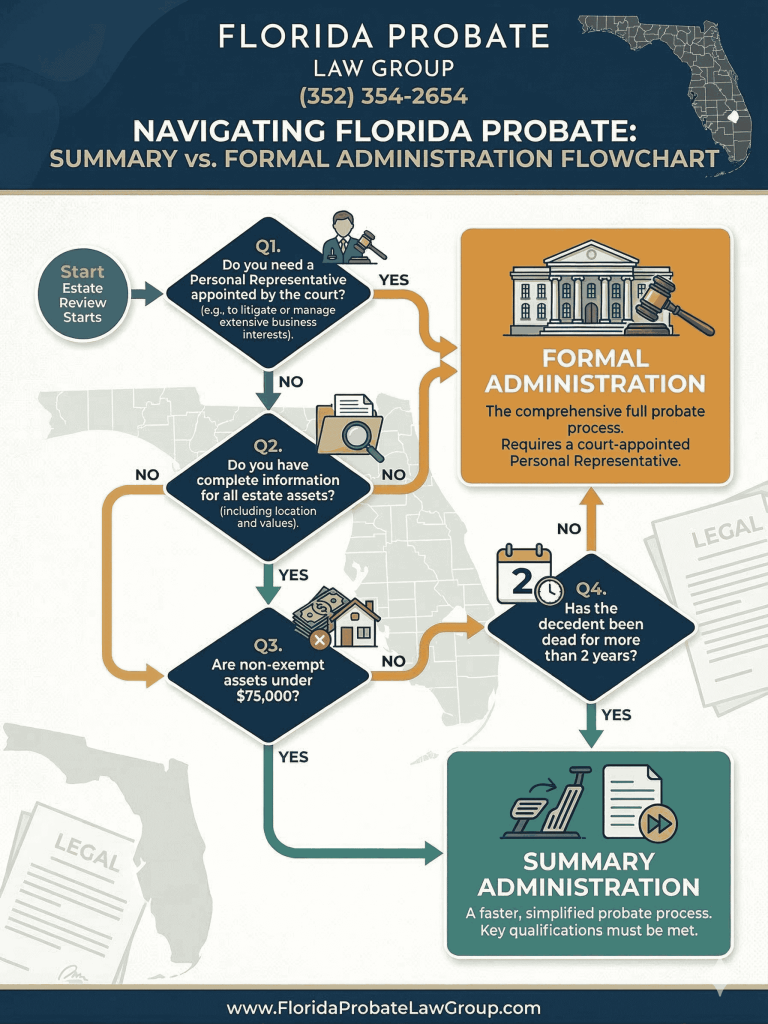
Not every Florida estate is eligible for this streamlined path. Florida law establishes clear qualifying criteria, and your estate must meet one of the two following primary conditions to proceed via summary administration:
1. Value of Non-Exempt Assets ≤ $75,000
The first potential qualification is based solely on the value of the estate’s non-exempt assets. If the total fair market value of all property subject to administration in Florida, excluding those assets deemed legally exempt, does not exceed $75,000, the estate may qualify for summary administration.
Understanding the difference between exempt and non-exempt assets is critical for this calculation. Certain assets, such as the decedent’s Protected Homestead Property (primary residence passed to a spouse or descendants), standard household furnishings up to $20,000 in value, and up to two motor vehicles, are generally considered exempt assets under Florida law and the state constitution. These exempt assets are protected from the decedent’s creditors (under most circumstances for homestead) and, importantly, do not count towards the $75,000 threshold.
Non-Exempt Assets include all other property owned by the decedent in their name alone without a designated beneficiary, such as:
• Bank accounts, investment accounts, or brokerage accounts without a “Pay on Death” or “Transfer on Death” designation.
• Non-homestead real estate, such as vacation homes, rental properties, or vacant land. Determining the correct value and homestead status of real estate often requires specialized knowledge, and you can explore this further in our county-specific probate guide for real estate, linked through our Florida Probate by County resources.
• Business interests or stock in closely held corporations.
• Valuable personal property not fitting the specific exempt property categories.
Accurately identifying and valuing all assets, and correctly applying exemptions, is vital. Miscalculations can unnecessarily push an eligible estate into a lengthy formal administration, increasing complexity and cost. Our experienced attorneys can provide a meticulous evaluation to determine if your estate meets this value threshold, leveraging our expertise, which we detail further in the Complete Guide to Florida Probate.
2. Decedent Deceased for More than Two Years
The second, separate condition for summary administration eligibility relates to the passage of time. If more than two years have elapsed since the decedent’s date of death, the $75,000 asset value limit no longer applies. In this situation, the value of the non-exempt assets is irrelevant, allowing potentially much larger estates to be settled through the streamlined summary administration process.
The significance of the two-year mark lies in Florida’s two-year non-claim statute (Florida Statute section 733.710). This law bars almost all creditor claims against an estate after two years from the date of death, effectively eliminating the need for the extensive creditor notification and payment process required in formal administration. In these “older” estates, the main purpose is simply the orderly transfer of title to the rightful heirs, making the expedited summary process ideal.
Our firm is committed to empowering clients across the state with trusted expert guidance, utilizing modern 2026 digital standards and an efficient 100% Remote Probate process. This ensures that no matter where you are located – within Florida, out of state, or even internationally – you can receive seamless legal assistance for estates anywhere in the sunshine state. We pride ourselves on price transparency and offer affordable flat fees for summary administrations ($3,500 inclusive of all court costs and US mailings as of 2026), eliminating unexpected hourly charges and providing peace of mind during a stressful time. With hundreds of 5-star Google reviews, our track record demonstrates our commitment to client satisfaction and exceptional legal service.
While significantly less complex than formal administration, summary administration still involves a formal legal procedure that must be meticulously followed. Our firm ensures every step aligns with 2026 digital filing standards, utilizing proprietary checklists and “Smart Forms” required by various Florida judicial circuits to prevent common errors that can delay cases in other firms. The general process entails:
1. Preparation and Petition Filing
The initial phase involves gathering all essential documents, including the decedent’s original Will (if one exists), a certified copy of the death certificate, and detailed information regarding all known assets and creditors. You must be able to particularly describe all assets, including specific account numbers and exact balances for financial accounts, as required by the court for inclusion in the final order.
Our attorneys then prepare a comprehensive “Petition for Summary Administration,” complying with all specific requirements in the relevant judicial circuit – local rules for petition content can vary significantly, which you can research for each area through our Florida Probate by County guides. This detailed petition must include specific information about the decedent, their beneficiaries or heirs, a complete inventory of non-exempt assets with values, a statement regarding debts, and whether the decedent died with or without a Will (testate vs. intestate). We then prepare the supporting notices, waivers, and often a Petition to Determine Homestead Status to accompany your petition for Summary Estate Administration.
2. Joinder and Consent
A crucial and sometimes challenging aspect is ensuring that all beneficiaries and, if applicable, a surviving spouse join in or consent to the summary administration petition. This unified approach guarantees the fastest possible resolution, and obtaining the necessary consent from potentially numerous or distant heirs requires precision. Our 100% Remote Probate process simplifies this significantly, utilizing secure electronic signature platforms that allow all parties to review and legally sign the petition digitally from anywhere, eliminating the need for physical paperwork or travel.
3. Notice to Interested Parties
All interested parties that have not signed waivers or joinders, including creditors (even if they are not getting paid), must be properly noticed of the Petition of Summary Administration and other relevant pleadings. This is achieved by sending a “Formal Notice” via certified mail. Once the recipient signs for the mail, they have a period of 20 days to object to your Petition for Summary Administration. After this time period is over, we submit a “Proof of Formal Notice” to the court establishing that all interested parties have received due process and allowing the court to issue orders transferring assets.
4. Judicial Determination of Homestead Real Property
For many Florida estates, the decedent’s primary residence is their most valuable asset. While protected from most creditors under the Florida Constitution (Article X, Section 4), this Homestead Property does not transfer title automatically upon death. Legally determining and officially titling homestead property is a sophisticated legal process, and success often relies on the deep judicial insight we bring to the table. founding partner, R. Nadine David, brings unique expertise, having served as a staff attorney for a Florida probate court before entering private practice. This perspective ensures our homestead petitions are built to anticipate court requirements and local procedural nuances, avoiding common pitfalls.
Within a summary administration that involves a homestead, we file a separate “Petition to Determine Homestead Status of Real Property” alongside the administration petition. This asks the judge to officially declare the property as legally protected homestead and authorize its direct transfer to the heirs or beneficiaries. Once the judge signs this specific Homestead Order, the property is legally confirmed as protected from the decedent’s general creditors and can be sold or transferred with a clear title. Understanding local county clerk property rules is essential for this determination, and you can explore this detail further in our city guides, linked through our Florida Probate by City resources.
5. Court Order and Asset Distribution
After reviewing the petition and confirming that provision has been made for any known debts (if death was <2 years prior), the judge typically signs and issues the final “Order of Summary Administration.” This conclusive court order officially directs the immediate distribution and transfer of the specified assets to each rightful beneficiary or heir named in the petition.
Financial institutions (banks, investment firms, etc.), government entities (Department of Motor Vehicles), and county clerks for non-homestead real estate are legally obligated to recognize the authority of this court order, allowing you to access accounts, titling vehicles, and transfer property without further court intervention. This direct-order-for-transfer capability, contrasting sharply with formal administration’s extensive procedural steps, is the primary driver of summary administration’s speed and efficiency – a powerful tool in our mission to secure your inheritance.
While summary administration is highly beneficial, it is not always the optimal choice, even if an estate technically qualifies. It is crucial to evaluate the specific circumstances, weighing the simplicity and speed of the expedited process against potential drawbacks.
Understanding the options available is the first step in efficiently securing your inheritance. We encourage you to explore our comprehensive resources, including our detailed The Complete Guide to Florida Probate for a broader context. For specific information about probate rules and court procedures relevant to a particular location, please consult our extensively detailed Florida Probate by County and Florida Probate by City guides.
Despite the apparent advantages of speed and cost, choosing summary administration over formal might not be advisable in several scenarios, even for estates that meet the qualifying criteria:
• Significant Creditor Claims (<2 years): If the decedent died less than two years ago and had substantial known or potential debts, formal administration may offer a more structured approach to managing and negotiating creditor claims, utilizing the personal representative’s powers. In contrast, under summary administration, heirs remain personally liable (Florida Statute section 735.206(4)) for the decedent’s debts to the extent of the value of the property they receive in probate, making creditor handling less defined and potentially more risky for beneficiaries. Local specificities for creditor handling and local rules vary, and you can explore this detail for your area in our extensive city probate guide, linked through our Florida Probate by City resources.
• Need to Investigate Assets or Access Medical Records: Since no personal representative is appointed, you lack the direct legal authority to investigate potentially hidden assets, gain access to sensitive medical records (useful for investigating potential claims or lawsuits, like a wrongful death action), or negotiate comprehensively with difficult institutions.
• Multiple Non-Homestead Real Estate Properties: Managing multiple pieces of non-homestead real estate, particularly in different counties, can add complexity that a personal representative is better equipped to handle under formal administration’s explicit powers. Local rules for real estate transfers also differ, and you can check county-specific rules for non-homestead properties through our Florida Probate by County guides.
• Potential Beneficiary Disputes: Formal administration provides more robust court oversight and specific timelines for disputing the validity of a Will or challenging distributions, offering greater protection if you anticipate significant conflict among heirs.
Even in a simplified summary administration, properly addressing homestead real property and creditors is crucial and requires specialized legal understanding. Florida’s strong homestead laws, detailed implicitly in The Complete Guide, provide unique protections but also require distinct legal petitions and court orders. Local county rules for real estate transfers and city-level specificities for homestead are paramount, and you can find extensively detailed information in our guides linked through our Florida Probate by County and Florida Probate by City resources.
Regarding creditors, while summary administration is streamlined, Florida law mandates a “diligent search and reasonable inquiry” for any known or reasonably ascertainable creditors before the Order of Summary Administration can be issued (for estates <2 years dead). This ensures all legal debts are addressed, though without the extensive notification requirements of formal administration. If debts cannot be immediately paid from non-exempt assets, provision for their payment must be made, making creditor handling less straightforward in summary administration compared to formal, and potentially city-level specifics for creditor search matter, which you can research through our Florida Probate by City resources. In contrast, estates where the decedent passed away over two years ago benefit significantly from the automatic barring of most creditor claims, simplifying the process immensely for these older administrations.
Summary administration in Florida is a streamlined probate process available for estates with less than $75,000 in non-exempt assets or when a decedent passed away more than two years ago. In order to file for summary administration the petitioner must be able to specifically identify estate assets (e.g. bank account numbers and balances). Unlike formal estate administration, summary administration does not provide for the appointment of a personal representative to do business on behalf of the estate.
An uncontested summary probate administration in Florida takes approximately 3 months, depending on the number of parties and creditors involved.
At Florida Probate Law Group, the total price of a summary administration is $3,500 including all court costs and mailing within the United States.
Exempt assets in Florida probate include the homestead property (residence that decedent owned and lived in prior to death), $20,000 in household furnishings, two vehicles under 15,000 pounds each, and $1,000 in personal property.
Yes. Exempt estate assets are exempt from creditor claims and do not count towards the $75,000 limit for summary probate administration, however they still must pass through the probate process to change ownership.
Any titled asset owned by the decedent at the time they passed away that does not have a joint owner or other means of automatic transfer to a living person must go through the probate process in Florida. Examples of assets that do not need probate in Florida include: jointly titled assets, assets with pay on death designations, assets owned by a trust, and real estate subject to a Ladybird deed.
No. Our specialized 100% Remote Probate process allows you to handle every aspect of your summary administration completely from your phone, computer, or tablet, no matter where you are located. We utilize secure electronic signatures, video conferencing, and digital court filing to ensure a seamless and convenient experience, eliminating the need for physical travel or court appearances. For local office contact information or city specificities, please refer to our Florida Probate by City guides.
Florida law requires the custodian of an original Last Will and Testament to deposit it with the Clerk of Court in the county where the decedent lived within 10 days of learning of their passing. Even if you are not ready to commence the probate process, you must ensure the original Will is deposited. This is a crucial procedural step to preserve the document and initiate the official legal record in the specific county, which you can find more information about in our Florida Probate by County guides. Failing to deposit a will within 10 days does not invalidate the will, but can make it more vulnerable to challenges.
If the decedent passed less than two years ago, provision must be made for the payment of all known or reasonably ascertainable debts before the court will grant the Order of Summary Administration. The petitioner must pay these debts or show the court there are sufficient non-exempt assets to cover them. As mentioned, if provision isn’t made, heirs may become personally liable (Florida Statute section 735.206(4)) for the decedent’s debts to the extent of the received property value. If the decedent has been deceased for more than two years, the two-year non-claim statute generally bars most creditor claims, allowing for distribution without requirement for creditor payment.
Yes, summary administration can effectively transfer title for non-homestead real estate, provided the fair market value of all non-exempt property (including this real estate) is $75,000 or less, or if the decedent passed over two years ago. The court order, once recorded in the county public records, serves as conclusive evidence of the transfer of title to the named beneficiaries. Managing multiple properties or properties across different counties, however, might make formal administration with a personal representative more practical due to county-specific rules, which you can check via Florida Probate by County guides.
Choosing the right legal partner is paramount, especially when navigating probate during a difficult time. At Florida Probate Law Group, we are committed to making summary administration as seamless, predictable, and stress-free as possible for families across all 67 Florida counties and major cities. Our approach is built on expertise, transparency, and modern efficiency:
• Experienced Statewide Probate Attorneys: Our specialized focus on probate and estate administration statewide, leveraging extensive experience in handling summary administrations in diverse counties. Local county and city specificities matter, and you can find extensive local detail in our guides linked through our Florida Probate by County and Florida Probate by City resources.
• Affordable Flat Fees and Price Transparency: We believe in predictable costs. Summary administrations are handled on a simple flat fee basis, providing complete clarity upfront and eliminating unexpected hourly charges. As of 2026, our flat fee for a Summary Administration is $3,500, which is all inclusive – we do not charge separately for court costs, hourly billing, mailing, and we never ask for a percentage of your inheritance.
• Judicial Insight and Efficient Digital Filing: With a founding partner’s unique court staff attorney background, we craft petitions that are accurate, compliant with specific circuit rules (which you can explore via county/city links), and designed to navigate court systems efficiently. We fully embrace digital standards, utilizing checklists and “Smart Forms” required across Florida judicial circuits, ensuring your case moves forward precisely and efficiently—the epitome of our Authority Engine philosophy.
• 100% Remote Probate for Maximum Convenience: Our specialized process ensures that you can complete the entire summary administration remotely, utilizing digital signatures and video conferencing, without ever needing to step into a courtroom or physically visit our office in person. This statewide remote capability allows us to serve clients across Florida and beyond with unparalleled ease.